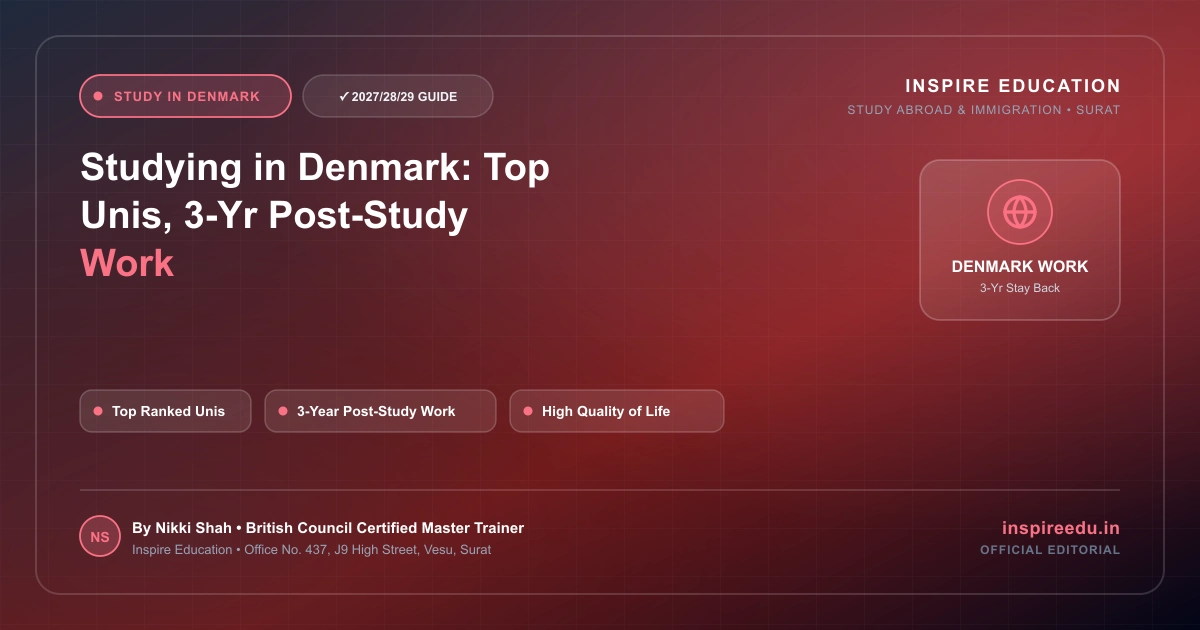
Denmark is continental Europe’s undisputed champion of renewable wind energy, life sciences, and balanced lifestyle. Home to top-tier technical institutions like DTU (Technical University of Denmark) and Copenhagen Business School (CBS), Denmark has introduced progressive post-study work regulations granting master’s graduates an automatic 3-year "Establishment Card" residence permit.
Key Takeaways & Policy Snapshot (At a Glance)
- Target Intakes: Fall, Spring & Winter 2027 and 2028 application cycles.
- Core Benchmark: Verified academic credentials, standard language test targets (IELTS, PTE, TOEFL, or CEFR French/German), and complete embassy financial solvency proof.
- Graduate Horizons: Post-study work authorization from 1 to 4 years with structured paths to global corporate careers and permanent residency.
- Surat Mentorship Desk: 1-on-1 profile evaluation, SOP verification, and consular mock interviews at Office No. 437, J9 High Street, Vesu, Surat.
Why Study in Denmark: World-Leading Institutions
Explore our Danish admissions counseling on our Study in Denmark in Surat Page. Key academic highlights include:
- DTU (Technical University of Denmark): Ranked among the world's top 10 engineering institutions for renewable energy, environmental engineering, and biotechnology.
- Copenhagen Business School (CBS): One of Europe's largest, triple-accredited business schools specializing in international business and supply chain logistics.
- University of Copenhagen & Aarhus University: Historic research giants leading in medicine, pharmacology (Novo Nordisk global ecosystem), and data science.
The 3-Year Establishment Card (Etableringskort) Advantage
Denmark offers one of the longest post-study work permits in Europe:
- Graduates from accredited Danish master's and PhD programs are eligible for a 3-year Establishment Card.
- Allows international graduates to work in any corporate position or establish an innovative start-up without requiring a separate work permit application during those 3 years!
Download the Official 2027/28 Checklist & Roadmap
Get the verified document checklist, intake deadlines, and admission requirements for 2027 & 2028 intakes curated by Inspire Education's senior mentors in Vesu, Surat.
High Student Wages & Working Rights
Living and working in Denmark:
- International students can work up to 20 hours per week during semester terms and full-time during June, July, and August.
- Denmark boasts high entry-level wages (DKK 130 to DKK 170 per hour in student assistant roles, approx. €18 to €23/hour), helping students offset living expenses.
Inspire Education Danish Admissions Practice in Vesu
Our Vesu team assists students with Optagelse.dk / DANS national portal applications, motivation letters, Danish Agency for International Recruitment and Integration (SIRI) residence permits, and biometric scheduling.
Frequently Asked Questions
Under current Danish immigration legislation, master’s graduates are granted a 3-year Establishment Card to work or establish a business.
Tuition fees at public Danish universities for non-EU students typically range from €8,000 to €15,000 per academic year.
Over 85% of Danish citizens speak fluent English, and multinational pharma/tech corporations in Copenhagen (Novo Nordisk, Maersk, Vestas) operate entirely in English.
SIRI requires proof of living expenses of approximately DKK 6,820 per month (around DKK 81,840 for a full year), held in the student’s bank account.
Non-EU application deadlines for master’s programs starting in September typically close on January 15 or March 1.
“Inspire Education handled my DTU application and SIRI residence permit. Graduating with a 3-year Establishment Card allowed me to join Vestas Wind Systems in Copenhagen!”
Recommended Next Reads in This Series
Study in Finland: World-Class Education & 2-Year Post-Study Visas
Explore Finnish university admissions and full scholarships.
Read Next Guide → Work RightsGlobal Post-Study Work Visas: Country-by-Country Comparison
Compare post-study work permits across European nations.
Read Next Guide →